
Operational risks
| Risk | Explanation | Mitigation |
| Business risks | ||
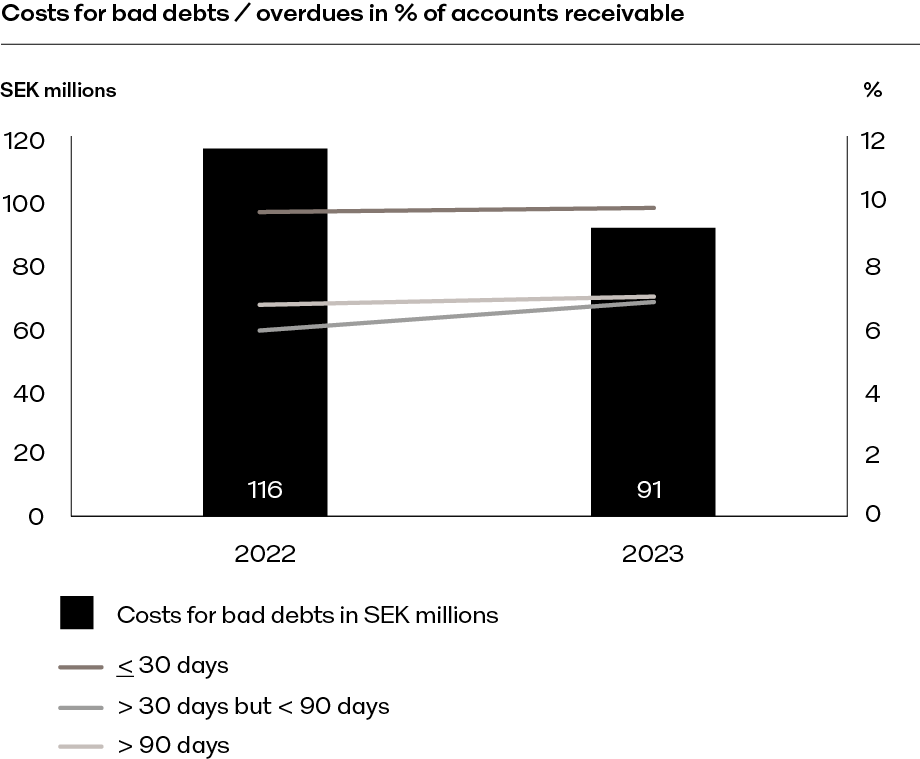
| Credit risk/Risk | The risk that the customer cannot pay for delivered goods due to financial difficulties. The amount of accounts receivable being overdue is an indication of the risk the company runs for ending up in a bad debt situation. The Group’s costs for bad debts and the overdues in percent of accounts receivable are presented in the following graph. | Alfa Laval has established a Group Credit Policy to manage and mitigate the credit risk. The Group sells to a large number of customers in countries all over the world. That some of these customers from time to time face payment problems or go bankrupt is unfortunately part of reality in an operation of Alfa Laval’s magnitude. All customers except Tetra Laval represent less than 1 percent of net sales and thereby represent a limited risk. Alfa Laval regularly collects credit information on new customers and, if needed, on old customers. Earlier payment habits have an impact on the acceptance of new orders. On markets with political or financial risks, the Group strives to attain credit insurance solutions. Accounts receivable constitutes the single largest financial asset according to Note 13. With reference to the above description, it is management’s opinion that there is no material concentration of risk in this financial asset. |
| Risk | Explanation | Mitigation |
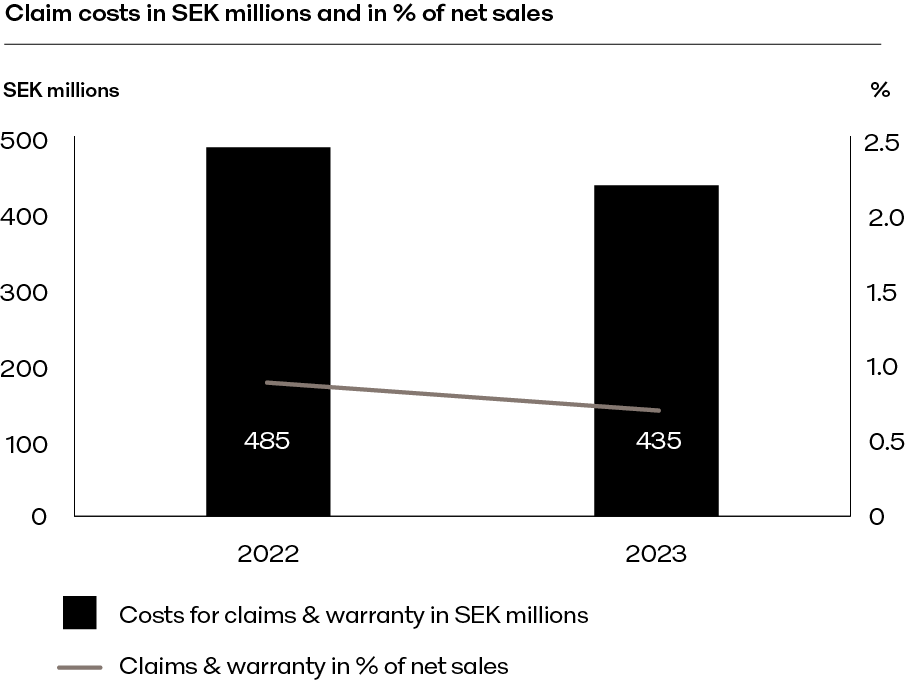
| Risk for claims | The risk for the costs Alfa Laval would incur to rectify faults in products or systems and possible costs for penalties. The Group’s net claim costs and their relation to net sales are found in the following graph. | Alfa Laval strives to minimize these costs through an ISO certified quality assurance. The major risks for claim costs appear in connection with new technical solutions and new applications. The risks are limited through extensive tests at the manufacturing site and at the customer site. |
| Economic risk | ||
| Competition | The Group operates in competitive markets, which can impact the company’s development negatively. | In order to address this competition, the Group has for instance: – organized the operations into divisions based on business units in order to get a customer focused market penetration; – a strategy for acquisition of businesses in order to for instance reinforce the presence on certain markets or widen the Group’s product offering; – worked with creating a competitive cost level based on its international presence; and – worked with securing the availability of strategic metals and components in order to maintain the ability to deliver. |
| Business climate | In an overall economic downturn, the Group tends to be affected with a delay of six to twelve months depending on business division. The same applies with an economic upturn. | The fact that the Group is operating on a large number of geographical markets and within a wide range of business units means a diversification that limits the effects of fluctuations in the business climate. Historically, fluctuations in the business climate have not generated decreases in orders received by more than approximately 10-15 percent. The downturn in the business climate in 2009 and 2010 however meant a considerably larger decline in order intake. This was partly due to the fact that the decline happened abruptly from a very high level of demand that was the culmination of a long-lasting boom and that the price level in connection with this peak was inflated by substantial increases in raw material prices. |
| Pandemics | The outbreak of the COVID-19 pandemic proved to have a large impact on the world economy and the international business climate. Lockdowns in many regions within countries or in entire countries did during certain periods limit Alfa Laval’s ability to visit potential customers and perform service on site at customers but did only to a limited extent impact the company’s supply chain and ability to manufacture products. Future pandemics can, depending on the rate of the spread of the infection and the risk for severe illness and death have smaller or larger consequences than COVID-19. | Global and local crisis management work and obedience to advice, instructions and rules from authorities are important to be able to short and long term handle the consequences of the pandemic. Cost reduction programmes and the flexibility in different national work time reduction schemes are important components to reduce costs to match the declining revenues. Employees outside the manufacturing have to a large extent been able to work from home. Travelling has been severely restricted and has to a large extent been replaced by digital meetings. |
| Risk | Explanation | Mitigation |
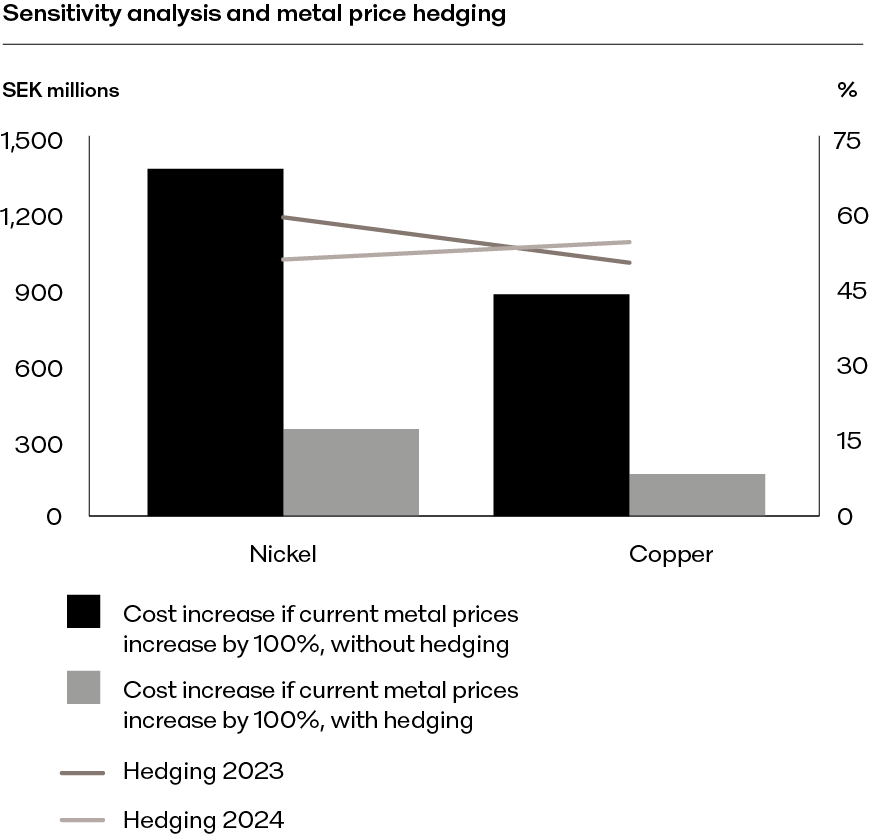
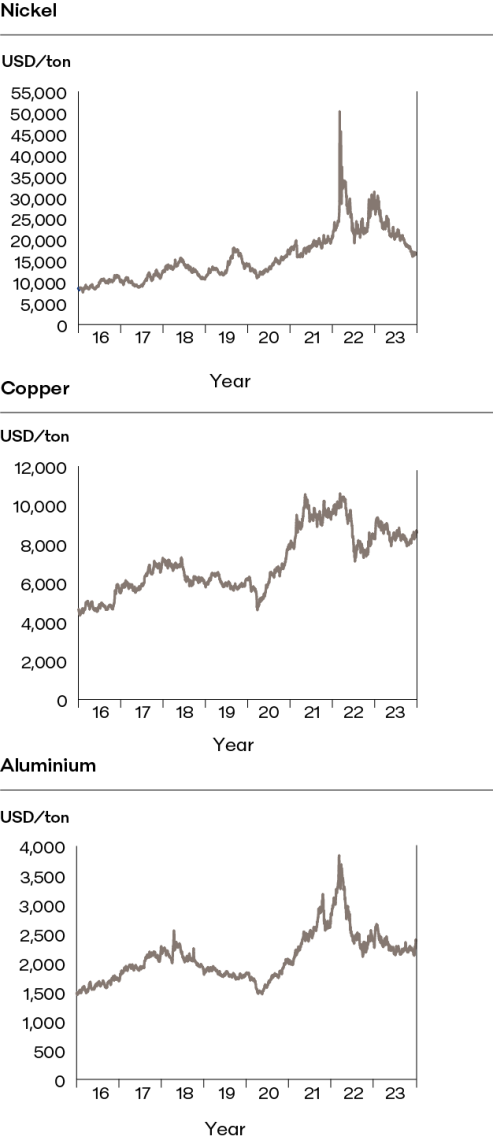
| Commodity prices | The Group depends on deliveries of stainless steel, carbon steel, copper and titanium etc and on electricity for the manufacture of products. The prices in some of these markets are volatile and the supply of titanium has occasionally been limited. There are a limited number of possible suppliers of titanium. The risk for severely increased prices or limited supply constitutes serious risks for the operations. The possibilities to pass on higher input prices to an end customer vary from time to time and between different markets depending on the competition. The below graph shows how much of the purchases of nickel and copper that have been hedged during 2023 and how much of the expected purchases during 2024 that were hedged at the end of 2023. The graph also presents to what extent the Group’s costs for these purchases during 2024 would be affected if the prices would double from the level at December 31, 2023. | The Group is addressing this risk by securing long-term supply commitments and through fixed prices from the suppliers during six to twelve months and through derivatives for metals and electricity. For metals: – The exposures for the coming 12 months of expected flows must be hedged between 30-70 percent. – In certain situations, exposures beyond 12 months can also be hedged. For electricity the coming 12 months’ expected exposure shall be hedged between 30-90 percent and the coming 13-24 months can be hedged up to 80 percent. During periods of large price increases the customer price on titanium products has been linked to Alfa Laval’s procurement costs for titanium. The Group has during certain periods experienced large price fluctuations for many raw materials, but in particular for stainless steel, carbon steel, copper and titanium. During 2023 the prices for nickel have decreased substantially. The price volatility for the most important metals is presented below.
The Group uses metal futures to secure the price on strategic metals. |
| Supply chain | During 2023 many companies have continued to experience the impacts and disturbances stemming from disrupted supply chains. Alfa Laval has suffered only limited continued impact from these disruptions. However, the current geopolitical developments and accentuated uncertainties, elevate the risk of new disruptions in coming years. | Alfa Laval has a global footprint with 37 major manufacturing units across Europe, Asia, the US and Latin America. The company has well-established business continuity plans and a global supply chain with alternative sourcing solutions for most products and services and close collaboration with key suppliers. |
| Risk | Explanation | Mitigation |
| Legal and compliance risks | ||
| Non-compliance with socioeconomic or environmental legislation | Alfa Laval’s global and diversified business means that the Group is required to adhere to a variety of laws and regulations. Failure to meet socio-economic or environmental requirements could lead to legal and financial consequences, and negatively impact the company’s reputation. | Policies, procedures and training programmes are in place to ensure that legal risks relating to its business activities are identified and that decisions are made on the appropriate level in the organisation. The legal counsel supports the business in identifying and handling these legal risks. A whistle-blowing system is in place where employees can report any breaches of laws or Alfa Laval policies anonymously without repercussions. |
| Bribery and | If Alfa Laval employees fail to comply with anti-bribery and anti-corruption laws, this could potentially lead to loss of business, financial penalties and reputational damage. | The Alfa Laval Anti-Bribery and Anti-Corruption Policy is applicable to all employees within the Group. The policy sets procedures for preventing, detecting, reporting and investigating acts of bribery and corruption. Training is a focus area to ensure an understanding of the risks associated with improper behaviour in this area. |
| Material source | Alfa Laval uses metals that may originate from areas classified as “conflict areas”. We manufacture products for customers with specific demands due to industry standards, for example marine, food and pharmaceutical customers. | Alfa Laval supports the US Securities and Exchange Commission’s rules and other initiatives concerning conflict minerals. Alfa Laval established a Conflict Minerals Policy in 2013. Due diligence is conducted in our supply chain to minimise the risk that minerals originate from conflict areas (especially in the Democratic Republic of Congo). Alfa Laval’s Supplier Risk & Compliance unit has processes in place to identify risks and monitor potential high-risk suppliers. The Alfa Laval Regulatory Operations unit monitors emerging legislation to ensure adherence in prioritized areas. |
| Unfair competition and antitrust | Infringements of applicable competition rules may result in Alfa Laval having to pay fines and losing goodwill. | The Fair Competition Policy provides guidelines to assist employees with how to adhere to competition law/antitrust laws, rules and regulation. Employees working with sales or purchasing are obliged to comply with this policy. |
| Export control | Breach of export control and trade sanction regulations can lead to a denial of trade privileges, criminal proceedings and reputational damage. | The Alfa Laval Export Control Policy establishes rules for Group-wide handling of the relevant export control regulations, adherence to applicable trade sanctions and it ensures that no products or services supplied by Alfa Laval are used in relation to weapons of mass destruction. |
| Risk for and in | This risk for the costs the Group may incur in managing litigations, costs in connection with settlements and costs for imposed penalties. The Group is involved in a few litigations, mainly with customers. | Any estimated loss risks are provided for. |
| Asbestos-related lawsuits | The Alfa Laval Group was as of December 31, 2023, named as a co-defendant in a total of 427 asbestos-related lawsuits with a total of approximately 427 plaintiffs. | Alfa Laval strongly believes the claims against the Group are without merit and intends to vigorously contest each lawsuit. Based on current information and Alfa Laval’s understanding of these lawsuits, Alfa Laval continues to believe that these lawsuits will not have a material adverse effect on the Group’s financial condition or results of operation. |
| Supply chain risks | ||
| Business Principles deviation in the supply chain | Deviations could have an adverse impact on people, the environment and society that could damage the company’s reputation. | Alfa Laval works to have a supply chain that follows laws and the company’s business principles. All suppliers sign contracts where they agree to abide by the Alfa Laval Business Principles. Suppliers are assessed based on a risk analysis (country/process) and high-risk suppliers are regularly audited. All employees within the procurement organisation and many suppliers are trained in all areas that are covered by the business principles. |
| Human Rights breaches | The risk that the human rights of individuals linked to Alfa Laval are violated. For example, child labour, forced labour and freedom of association. | Alfa Laval’s Business Principles build on the UN Global Compact, the OECD Guidelines for multinational enterprises, the UN Guiding Principles for Business and Human Rights and incorporate the UK Modern Slavery Act. Suppliers sign off on these business principles in their contracts with Alfa Laval. High-risk suppliers are also audited that they follow the business principles. |
| Risk | Explanation | Mitigation |
| Production or product related risks | ||
| Risk connected | The risk that a competitor develops a new technical solution that makes Alfa Laval’s products technically obsolete and therefore difficult to sell. | Alfa Laval makes a deliberate investment in research and development aiming at being in the absolute frontline of technical development. |
| Risk for technically related damages | The risk for the costs Alfa Laval may incur in connection with a product delivered by the Group breaking down and causing damages to life and property. The main risk in this context concerns high-speed separators, due to the large forces that are involved when the bowl in the separator spins with a very high number of revolutions. In a breakdown the damages can be extensive. | Alfa Laval makes extensive testing and has an ISO certified quality assurance. The Group has product liability insurance. The number of damages is low and few damages have occurred historically. |
| Health & Safety | Health and safety risks such as occupational diseases and accidents. The risk that an employee is injured or killed in a workplace accident. | The Alfa Laval Occupational Health & Safety (OHS) Policy guides the work together with our OHS Manual. The purpose with these is to safeguard a healthy and safe working environment by preventing accidents, occupational diseases and other health risks. We have a process to continuously monitor high-risk areas in our operations, train employees and enforce changes. |
| Environmental risks | ||
| Major environmental incident at a site | An incident that causes a significant environmental damage could lead to long-term environmental impact, negative impact on people, fines and reputational damage to the company. | The Alfa Laval Environmental Policy is applicable to the entire Alfa Laval Group. Environmental performance is monitored and measured through Environmental Management Systems. The large sites are ISO 14001 certified. Smaller sites work according to Environmental Management Systems where risks are identified, and effective countermeasures are implemented. |
| Use of hazardous chemicals | Using hazardous chemicals could lead to severe illness or have a serious negative impact on our environment or society. | The Alfa Laval Group Restricted Substance List (former Alfa Laval Group Black & Grey List) is the primary tool to control the use of hazardous chemical substances. The list comprises legislations and global agreements deemed relevant for our products and area of business with an annexed list of the concerned substances. It is updated annually to reflect any legislative changes. The substances in the Restricted Substance List is divided in three categories: Banned, Restricted and Substances of Concerns. |
| Climate and water | Climate change and water scarcity can lead to increased costs and constraints on production. Apart from legislative and other transition risks arising from society’s attempts to mitigate climate change, Alfa Laval faces potential physical climate-related risks from extreme weather events that may impact asset and business values. | Alfa Laval is working actively to mitigate the climate impact in its own operations and the value chain. Progress is being made towards the science-based targets for 2030 to reduce scope 1 and 2 emissions by 95 percent and scope 3 emissions by 50 percent from a 2020 baseline. Alfa Laval does not use a significant amount of water, yet the target to decrease water consumption in water-stressed areas by 5 percent from 2020 to 2023 was surpassed, achieving a 17 percent reduction. In late 2023, Alfa Laval carried out an in-depth assessment of climate related physical risks based on IPCC climate scenarios. The results will be further analysed and appropriate actions taken during 2024. |
| IT related risks | ||
| Loss of intellectual property, financial or personal data | Loss of intellectual property, financial or personal data due to for instance unauthorized access to Alfa Laval’s computer systems. | Alfa Laval holds compulsory trainings on information security awareness. Policies describe what is confidential information and how the information should be classified. Alfa Laval’s IT agreements contain the necessary Information Security components. Information security is also monitored in our project model – feasibility, pre-study and project. A template is also sent at an early stage to all potential suppliers to identify if there are any possible infringements of information security. |
| Risk | Explanation | Mitigation |
| Human capital risks | ||
| Risk connected to attracting and retaining talents | Companies that do not succeed in attracting and retaining talents risk experiencing an inferior development compared to companies that succeed with this. | To offer interesting positions, personal and professional development, a good working environment and competitive compensation and benefits are prioritized areas within Alfa Laval. |
| Other risks | ||
| Business | The risk that single units or functions within the Group can be hit by business interruption due to: – strikes and other labour market conflicts; – fires, natural catastrophes etc.; – computer access violations, lack of; backups etc.; and – corresponding problems at major | Alfa Laval has a well-developed dialog with the local unions, which reduces the risk for conflicts and strikes where Alfa Laval is directly involved. It is however more difficult to protect the company against conflicts in other parts of the labour market, for instance within transportation. Alfa Laval is minimizing the following two risks through an active preventive work at each site in line with the developed global policies in each area under supervision of manufacturing management, the Group’s Risk Management function, Real Estate Management, IT and HR. Problems at major sub-suppliers are minimized by Alfa Laval trying to use several suppliers of input goods that when needed can cover up for a drop in production somewhere else. The wish for long-term and competitive delivery agreements however puts restrictions on the level of flexibility that can be achieved. When there is a shortage, the total supply may be too limited to allow exchangeability. The production facility in Lund in Sweden, which is the Group’s largest is together with some of our more important sites annually reviewed by third party risk engineers to secure that our key production facilities are being evaluated and protected to highest standard possible. All sites are part of the survey program but with different frequency. |
| Political risk | The risk that the authorities, in the countries where the Group is operating, by political decisions or administration make continued operations difficult, expensive or impossible for the Group. | The Group is mainly operating in countries where the political risk is considered to be negligible or minor. The operations that are performed in countries where the political risk is deemed to be higher are not material. |
| Insurance risks | These risks refer to the costs that Alfa Laval may incur due to an inadequate insurance coverage for property, business interruption, liability, transport, life and pensions. | The Group strives to maintain an insurance coverage that keeps the risk level at an acceptable level for a Group of Alfa Laval’s size and still is cost efficient. At the same time a continuous work is going on to minimise the risks in the operations through proactive measures. |
| Risks connected to credit terms | The limited freedom of action that can be imposed on the Group through restrictions connected to credit terms in loan agreements. | Alfa Laval’s strong solidity and profitability limits this risk. |