
Marine Division
The division’s customers include shipowners, shipyards, manufacturers of diesel and gas engines, as well as companies that work with offshore extraction of oil and gas. The offering includes pumping systems, boilers, heat transfer equipment, high speed separators, digital solutions and several different environmental products, including systems to clean ballast water and exhaust gases.
The Marine Division consists of four Business Units: Pumping Systems, Water, Wind & Fuel Solutions, Heat & Gas Systems and Digital Solutions.
| Marine Division | ||
| Consolidated | ||
| SEK millions | 2023 | 2022 |
| Orders received | 23,960 | 19,442 |
| Order backlog 1) | 19,273 | 14,122 |
| Net sales | 19,049 | 16,370 |
| Operating income 2) | 2,178 | 1,741 |
| Adjusted EBITA 3) | 2,836 | 2,399 |
| Adjusted EBITA margin 4) | 14.9% | 14.7% |
| Depreciation | 336 | 312 |
| Amortisation | 658 | 658 |
| Investments 5) | 336 | 235 |
| Assets 1) | 29,856 | 30,932 |
| Liabilities 1) | 7,998 | 7,241 |
| Number of employees 1) | 5,655 | 5,465 |
1) At end of period. 2) Excluding comparison distortion items. 3) Alternative performance measure. 4) Adjusted EBITA/net sales. 5) Excluding new leases.

Order intake
| Order bridge | ||
| Consolidated | ||
| SEK millions/% | 2023 | 2022 |
| Order intake last year | 19,442 | 15,379 |
| Organic 1) | 19.9% | 14.8% |
| Structural 1) | 1.6% | 3.3% |
| Currency | 1.7% | 8.3% |
| Total | 23.2% | 26.4% |
| Order intake current year | 23,960 | 19,442 |
1) Change excluding currency effects.
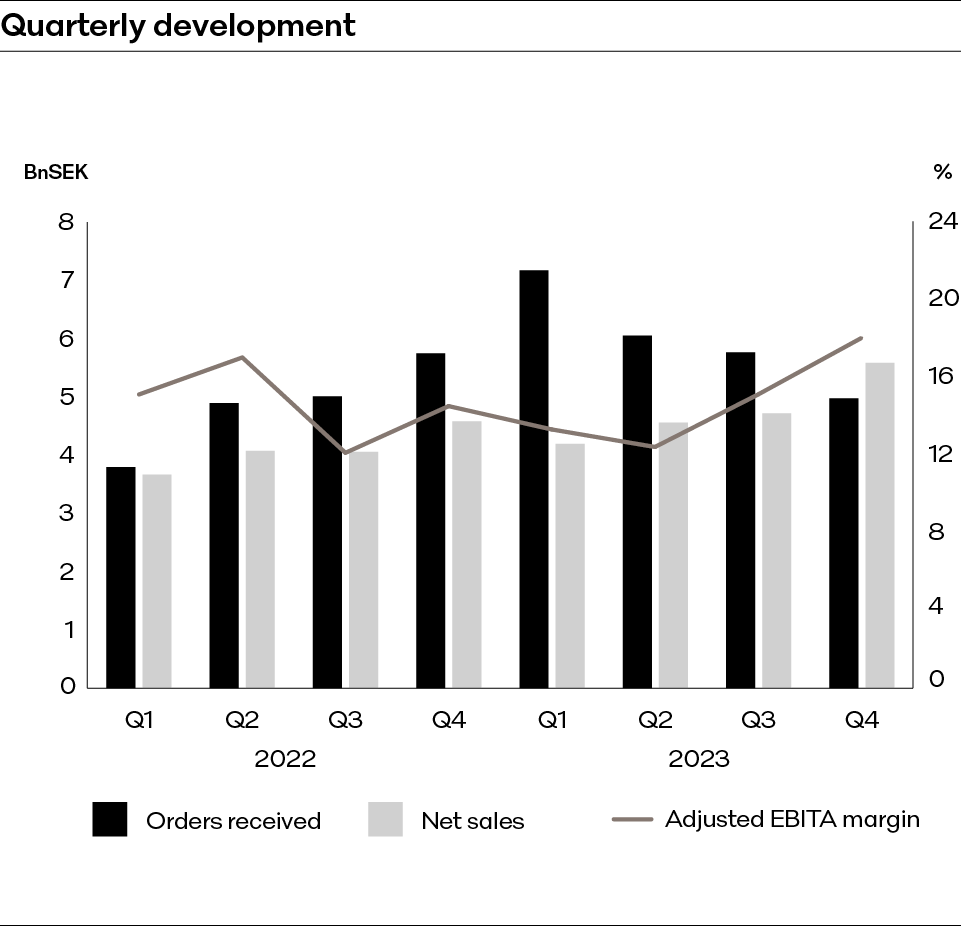
The order intake for the Marine Division increased compared to last year. Growth was driven by a stronger demand in most product areas and in the service business.
The underlying market sentiment related to the building of new vessels was on a higher level compared to last year. New contracting has been driven primarily by tankers and vehicle carriers, supported by a fair level of contracting in the other ship segments as well. The increased shipbuilding activity has been further supplemented by a continued growing demand for sustainability related solutions which mitigate CO2 emissions, including solutions around energy efficiency and low and zero carbon fuels. Demand for PureBallast has as expected eased further as fewer vessels remain to be retrofitted before the approaching 2024 regulatory deadline and the market gets more oriented to new vessels. Multi-fuel capable solutions continue to gain traction. Order intake for offshore increased significantly compared to last year and the underlying market sentiment in this area remained strong due to increased oil prices and new projects to safeguard long term energy supply.
Order intake for service improved compared to last year. Growth was driven by strong activity levels in both shipping and offshore, a growing environmental installed base and regulatory compliance related services. High freight rates in most vessel segments and the need to keep vessel assets in good operational readiness resulted in increased on-board maintenance and higher demand for spare parts and service.

Net sales
| Sales bridge | ||
| Consolidated | ||
| SEK millions/% | 2023 | 2022 |
| Net sales last year | 16,370 | 13,888 |
| Organic 1) | 11.7% | 7.4% |
| Structural 1) | 1.5% | 3.4% |
| Currency | 3.2% | 7.1% |
| Total | 16.4% | 17.9% |
| Net sales current year | 19,049 | 16,370 |
1) Change excluding currency effects.
Net sales were at a higher level than last year. Sales growth for service and for most product groups in capital sales, offset the lower sales for PureBallast.
Adjusted EBITA
| Income bridge | ||
| Consolidated | ||
| SEK millions | 2023 | 2022 |
| Adjusted EBITA last year | 2,399 | 2,811 |
| Volume 1) | 774 | 527 |
| Mix 1) | -286 | -503 |
| Costs 1) | -67 | -539 |
| Currency | 16 | 103 |
| Adjusted EBITA current year | 2,836 | 2,399 |
1) Change excluding currency effects.
The adjusted EBITA increased compared to last year, where the first half of the year was still burdened by unbalanced factory loads and invoicing of backlog with lower margin yields due to uncompensated cost increases from the date of booking. The second half of the year benefitted from higher invoicing volume, a more balanced factory load, the impact of restructuring activities that were announced in the fourth quarter 2022 and a margin accretive mix. The cost continued to be impacted by inflationary pressure but was partially offset by a positive currency effect.