
Information about geographical areas
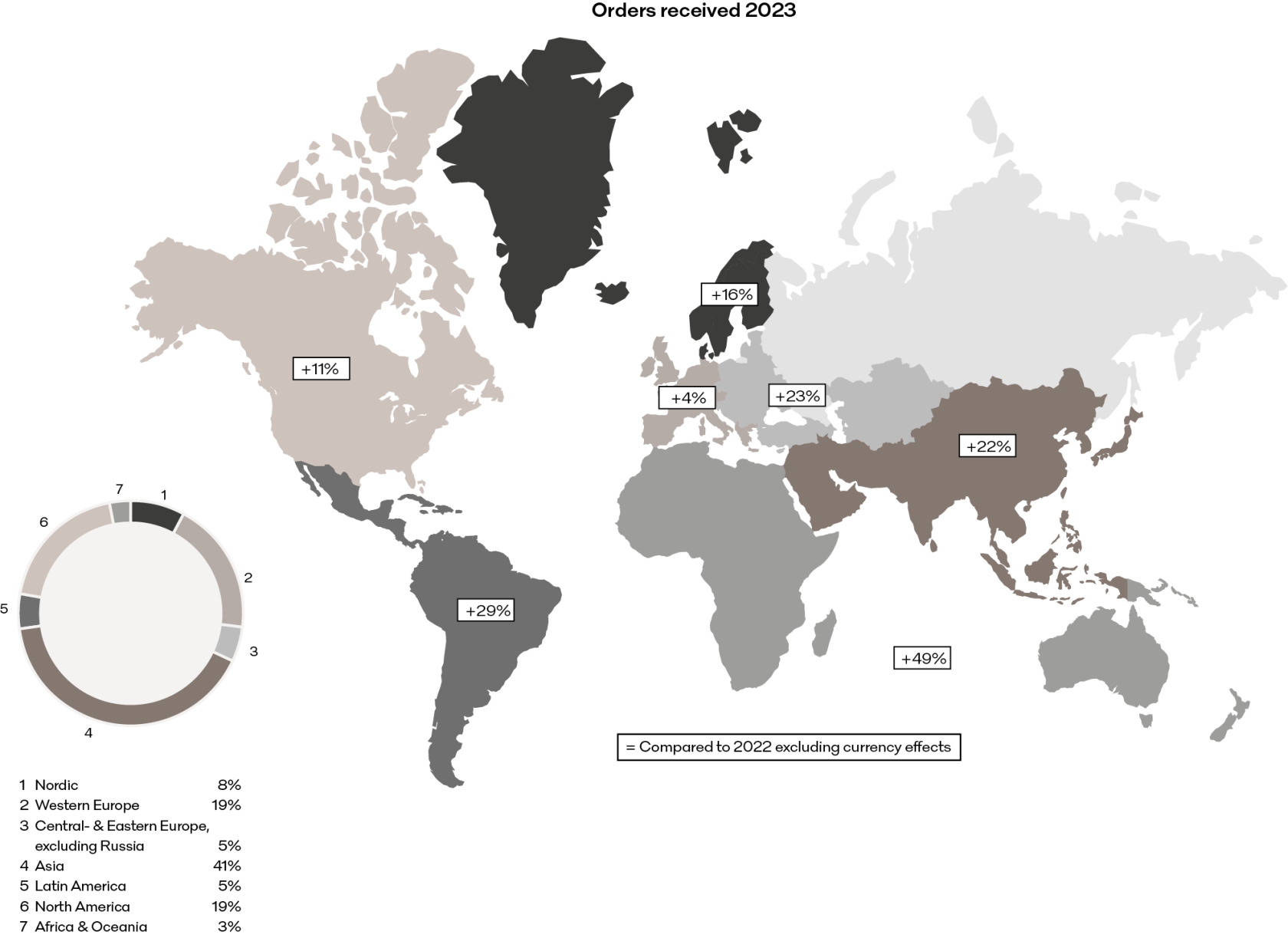
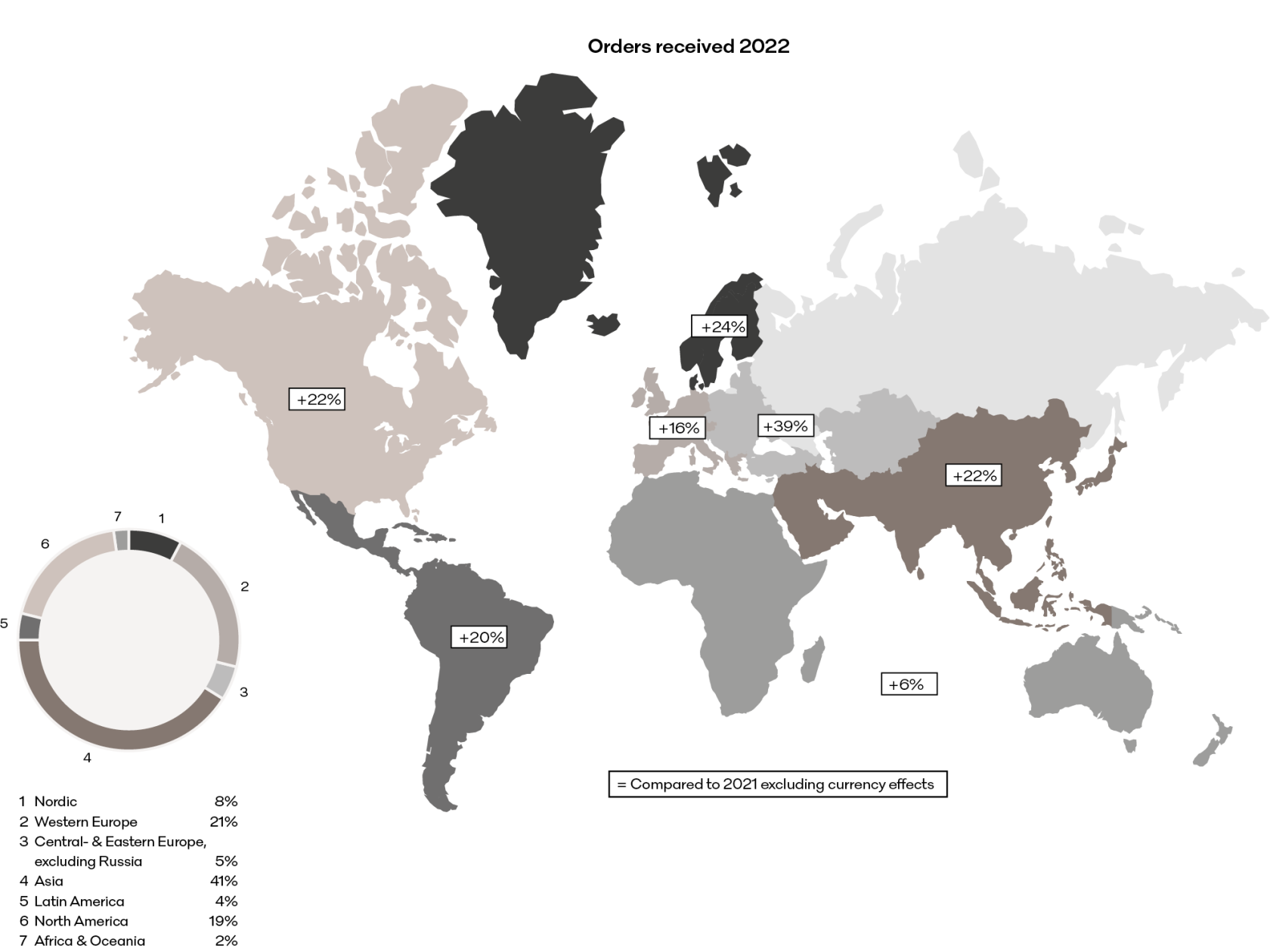
All comments are excluding currency effects.
Western Europe including Nordic
The order intake in the region showed growth compared to last year. Energy showed growth in almost all markets, driven by a high demand from the power and HVAC industries. However, the HVAC demand slowed down during the year. Food & Water grew well in Benelux, France and Nordic, particularly in protein and prepared food & beverage. Marine grew in Nordic, Benelux and United Kingdom supported by good development in shipbuilding and shipping. Service had a good development and grew.
Central and Eastern Europe
The region reported growth in order intake compared to last year in almost all markets. In Energy the growth was primarily driven by continued demand for HVAC and refrigeration. However the HVAC demand slowed down during the year. Food & Water reported growth in most of the countries in the region primarily driven by protein and ethanol, starch & sugar. Marine reported a decline in the region, mainly driven by less demand for PureBallast within shipbuilding. Service order intake grew strongly.
North America
North America reported strong growth in order intake compared to last year. In Energy the growth was particularly strong for oil & gas and refinery in the U.S. Food & Water noted growth for oils & fats and ethanol, starch & sugar. Marine reported growth in engine power. Service order intake had a strong growth.
Latin America
The region showed strong growth in order intake compared to last year. Energy had a high demand in refinery and oil & gas in most countries in the region. Food & Water reported strong growth in most countries in the region primarily driven by oils & fats and ethanol, starch & sugar. Marine showed strong growth in most countries in the region primarily driven by engine power. Service order intake had a strong growth.
Asia
The region reported strong growth in order intake compared to last year. Energy reported growth and it was particularly high in the Middle East, India and Thailand driven by oil & gas and power. HVAC in China had a good start of the year, but the demand slowed down during the year. Growth in Food & Water was particularly high in Indonesia, Thailand and India driven by a continued demand in oils & fats and brewery. Marine reported good growth in China, Taiwan and Malaysia driven by increased order intake from both shipbuilding and shipping. Service developed well and grew.
Africa and Oceania
The order intake in the region showed growth compared to last year. Energy had a high demand in power and process industry in Australia and Africa. Food & Water reported growth in the region driven by protein and brewery. Marine reported a weaker demand for oil & gas. Service order intake was weaker than last year.
Personnel
The number of employees is measured and reported as full time equivalents.
The parent company does not have any employees.
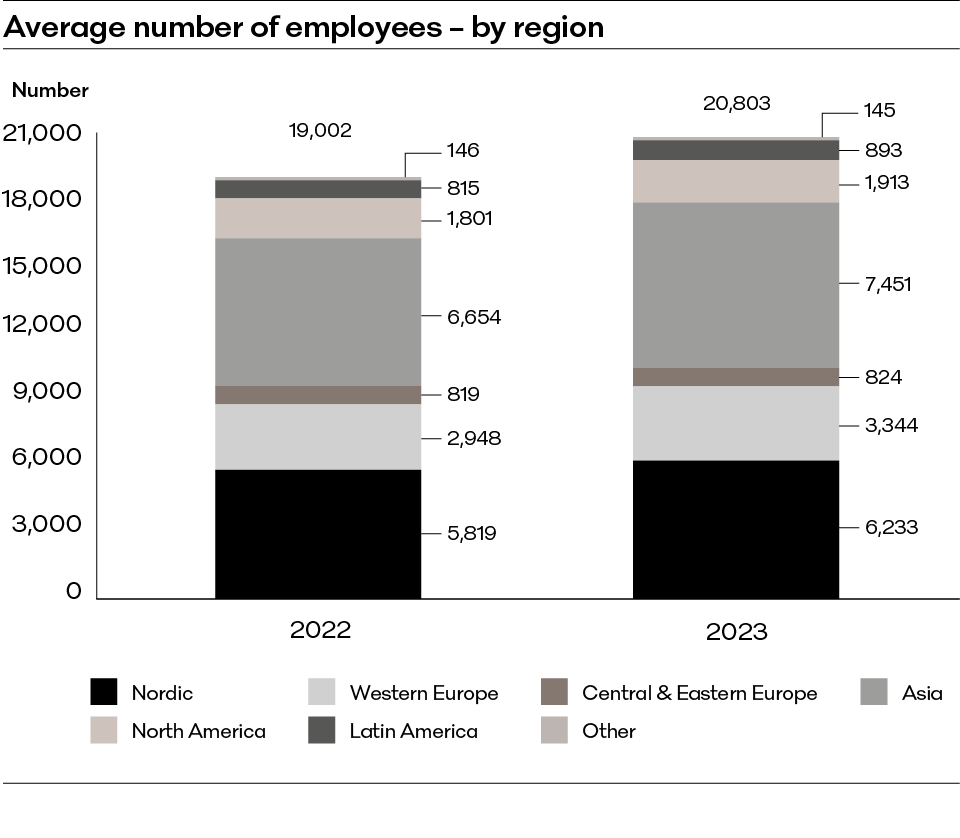
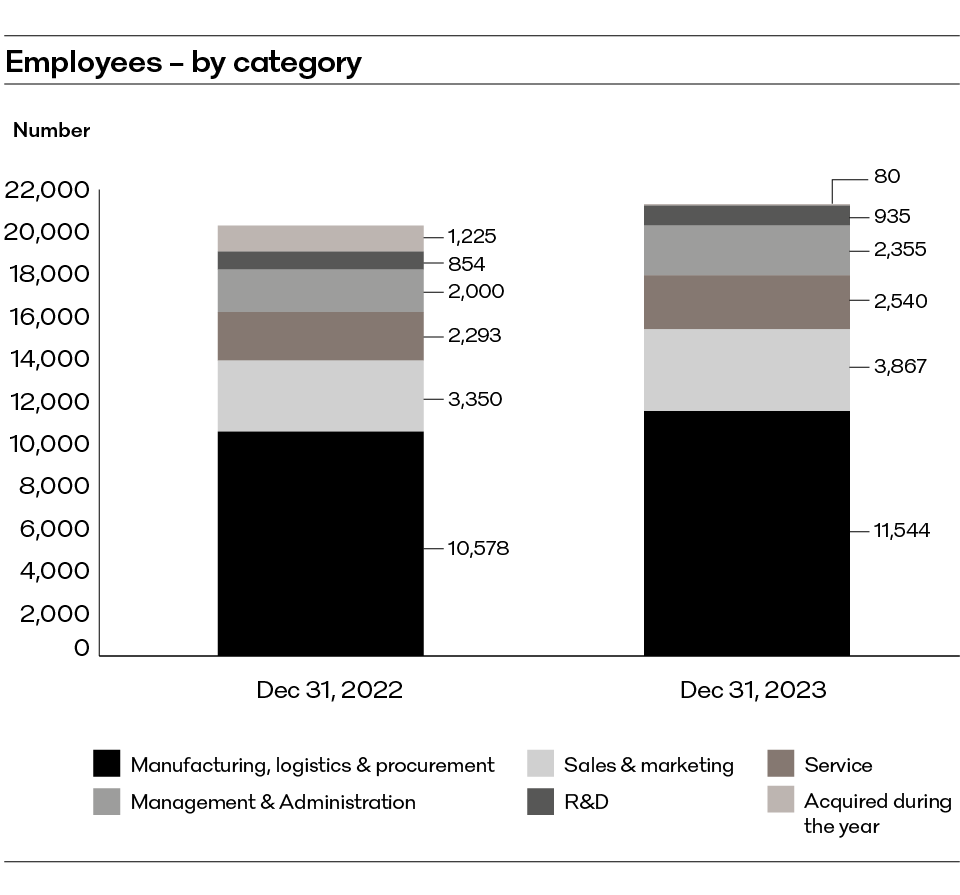
The Group has on average had 20,803 (19,002) employees. At the end of December 2023, the Group had 21,321 (20,300) employees. The employee turnover rate excluding temporary employees for 2023 is 5.9 (6.9) percent. The highest employee turnover rate in 2023 is found in management & administration and manufacturing, logistics & procurement.
Alfa Laval has the ambition to develop the employees on all levels within the Group. The largest part of the competence development takes place in the daily work when our employees continuously get more demanding tasks as well as get the opportunity to participate in different projects together with more experienced colleagues. Local training and development efforts in the different factories and sales companies around the world are equally important, for instance ALPS (Alfa Laval Production System) that is based on the well-known concepts of Lean and Six Sigma and also on ALPAS (Alfa Laval Product & Application School). The ALPAS trainings are designed and developed by the product responsible Business Unit.
All training programmes and development projects are performed within the Alfa Laval Academy framework, to ensure they follow the Alfa Laval Learning Principles. Further examples of such training programmes are Challenger (for young talents with international leadership potential), Evolve (training and mentor programme for employees with high potential in leadership positions), Project Management, Information Security (mandatory training via E-learning), Inclusion & Diversity (for all employees), Pure Leadership (for middle management) and Drive (for senior management).
Alfa Laval has a global certification in “Learning Facilitation Capabilities” called “Licence to Train” to secure quality and consistency in the way we deliver our learning programmes internally as well as towards customers and partners.
Alfa Laval is promoting inclusion and diversity at all levels to give all employees fair and equal opportunities for development and career. While we consciously work towards increasing the share of female managers and the share of female employees in the total workforce, leadership programs like Challenger, Evolve and Drive are important to drive the shift in leadership and inclusion to reach the goal.
The distribution of the number of employees by region is:
The distribution of the number of employees by personnel category at year end is:
The productivity by employee has developed as follows:
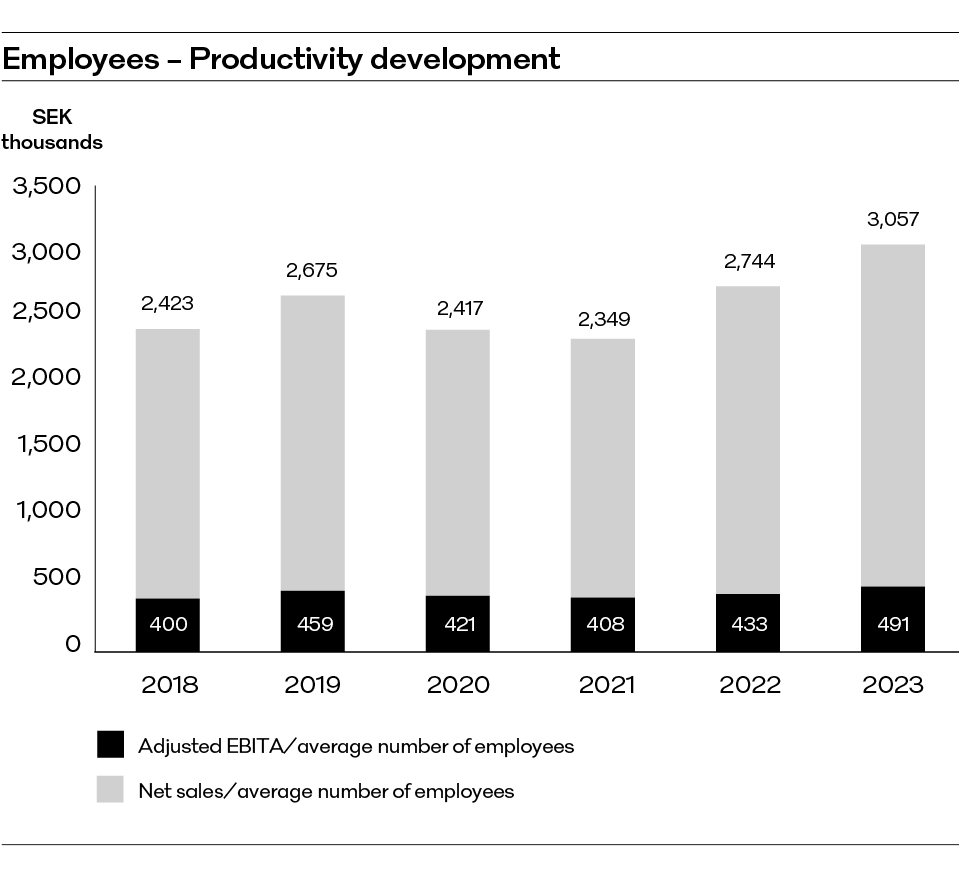
The improvement for 2019 was impacted by the change programme that was launched during the autumn 2016 but reinforced by the stronger demand within primarily environmental products and the weakening of the Swedish krona. The deterioration during 2020 and 2021 is explained by the consequences of the COVID-19 pandemic and the stronger Swedish krona. The improvement during 2022 is explained by the increased sales and the weakening of the Swedish krona. The weaker development of the profitability during 2022 is due partly to increased raw material prices in combination with invoiced backlog taken prior to 2022 and the Desmet project business and partly to capacity imbalances in the supply organization and the impact of the transition from fossil to sustainable energy solutions for parts of the Marine Division and the Business Unit for Welded Heat Exchangers in the Energy Division. The latter was being addressed in the announced restructuring programme.
In 2023 there was a marked increase in both adjusted EBITA and net sales per employee. The increase of adjusted EBITA per employee was primarily driven by the improvements yielded by the restructuring programs, a positive mix effect from service business offsetting higher project invoicing and the increased volume impact of sales that increased with 22 percent. The latter offset absorption imbalances in some manufacturing units, negative currency and material hedges and inflationary pressure. The increased net sales per employee was driven by more than half by the organic sales growth, 22 percent by currency and 24 percent by structural additions.
The distribution of employees per country and per municipality in Sweden and between males and females can be found in Note 5 in the notes to the financial statements. The specification of salaries, wages, remunerations, social costs and pension costs are provided in Note 6 in the notes to the financial statements.
Remuneration policy for executive officers
The remuneration policy for executive officers is established by the Annual General Meeting, see further description in Note 6 and the complete policy in Note 37.
The Board of Directors decided in 2023 to implement six of the modified cash based long-term incentive programme for maximum 95 senior managers in the Group including the Chief Executive Officer and the persons defined as executive officers. The outcome of the modified programme depends on how the adjusted EBITA margin and the net sales growth have developed during a three-year period, with a 50/50 weight between the targets. This means that there will be no award during the first two years since it is first in year three that it can be determined to what extent the targets have been achieved. Maximum outcome is awarded when the targets are exceeded. The remuneration from the modified long-term incentive programme can constitute maximum 25, 40 or 50 percent of the fixed remuneration depending on position. Payment to the participants in the programme is made after year three and only provided that they are still employed at the date of payment.
Research and development
As the result of an intensive and consistent commitment over many years to research and development, Alfa Laval has achieved a world-leading position within the areas of separation and heat transfer. The product development within fluid handling has resulted in a strong market position for a number of products. In order to strengthen the Group’s position and to support the organic growth, by identifying new applications for existing products as well as developing new products, research and development is always an activity of high priority. Research and development is conducted at approximately twenty facilities around the world.
The costs for research and development have amounted to SEK 1,563 (1,356) million, corresponding to 2.5 (2.6) percent of net sales. Excluding currency effects and acquisition/divestment of businesses, the costs for research and development have increased by 7.9 percent compared to last year.
Ethics and social responsibility
Two of Alfa Laval’s four business principles are: ”Respect for human rights is fundamental” and ”High ethical standards guide our conduct”. This means that Alfa Laval respects human rights and the very different social cultures in which the company works and supplies its products and services and that Alfa Laval conducts its business with honesty, integrity and respect for others.
Globalisation gives Alfa Laval new business opportunities for increased sales as well as lower costs for manufacturing the products. But when part of the supply chain is moved to countries with lower costs the company is often confronted with ethical questions in a more obvious manner. Health, security and working conditions for the employees at the company’s suppliers are some of Alfa Laval’s main topics. When Alfa Laval procures products from quickly growing economies like China and India it is important for the company to secure that the cost reduction opportunities are not at the expense of those performing the work in each country. Alfa Laval regards it as an obligation to make sure that its suppliers develop quickly if the work, health and security conditions are not acceptable.
Alfa Laval has developed an internal training programme to give salespeople and purchase departments knowledge on legal business practice.
Environment
One of Alfa Laval’s four business principles is: ”Optimizing the use of natural resources in the most efficient manner is our business.” The company’s products make a significant contribution to reducing the environmental impact of industrial processes and are used to produce renewable energy.
All sites have an environmental management system in place. More than 95 percent of the delivery value comes from production sites with ISO 14001 certification.
The subsidiary Alfa Laval Corporate AB is involved in operational activities that are subject to an obligation to report and compulsory licensing according to Swedish environmental legislation. The permits mainly relate to the manufacturing of heat exchangers in Lund and Ronneby and the manufacturing of separators in Eskilstuna. The impact on the external environment is through limited discharges into the air and water and through waste and noise.
The foreign manufacturing sites within the Alfa Laval Group are engaged in operational activities with a similar effect on the external environment. To what extent this activity is subject to an obligation to report and/or compulsory licensing according to local environmental legislation varies from country to country. Alfa Laval has an overall intention to operate well within the limits that are set by local legislation.
Russia’s war on Ukraine
Alfa Laval had a factory and a sales company in Russia and a sales company in Ukraine. Historically the order intake from the markets in Russia and Ukraine has been approximately SEK 1 billion per year, equivalent to 2 percent of the total order intake for the company. When the war started on February 24, 2022, the total order backlog in Russia and Ukraine amounted to approximately SEK 750 million. In addition, Alfa Laval companies in other countries had orders from Russian end customers of SEK 360 million. Since then, the order backlog has been re-assessed and as a result orders of SEK 973 million have been removed from the order backlog. This is mainly due to sanctions, but also when Alfa Laval has assessed that the company will not be able to deliver or get paid. Also orders where Alfa Laval supplies equipment to ship yards in other countries building ships for ship owners under sanctions have been removed from the order backlog.
In the interim reports and the annual report for 2022 a detailed description was made of how Alfa Laval has calculated and provided for the company’s costs for cancelled orders, late delivery fees, accounts receivable that we do not believe we will get paid for, foreign exchange losses and advance payments to suppliers in Russia and Ukraine where we do not expect any delivery or the advance being repaid to us.
Before the war, Alfa Laval had a competent team of approximately 230 employees in Russia and 10 employees in Ukraine. At December 31, 2023 the number of employees in Russia had decreased further down to 6. Alfa Laval’s assessment is that the longer-term implications of the war on the Russian market are of such a magnitude that the company in the fourth quarter 2022 provided for a closure of the operations. The total cost for these provisions amounted to SEK 400 million and was reported as a comparison distortion item in the first quarter 2022 with SEK 327 million and in the fourth quarter 2022 with an additional SEK 73 million.
Asbestos-related lawsuits
The Alfa Laval Group was as of December 31, 2023, named as a co-defendant in a total of 427 asbestos-related lawsuits with a total of approximately 427 plaintiffs. Alfa Laval strongly believes the claims against the Group are without merit and intends to vigorously contest each lawsuit.
Based on current information and Alfa Laval’s understanding of these lawsuits, Alfa Laval continues to believe that these lawsuits will not have a material adverse effect on the Group’s financial condition or results of operation.
Restructuring program
A restructuring program covering parts of the Marine Division and the Business Unit for Welded Heat Exchangers in the Energy Division was initiated in the fourth quarter 2022 to adjust capacity imbalances in the supply organization and manage the impact as we transit from fossil to sustainable energy solutions. The program was completed during 2023.
Result for the parent company
The parent company’s result after financial items for 2023 was SEK 4,271 (95) million, out of which dividends from subsidiaries SEK 4,037 (62) million, net interests SEK 252 (44) million, realised and unrealised exchange rate gains and losses SEK -1 (2) million, costs related to the listing SEK -4 (-4) million, fees to the Board SEK -9 (-9) million, cost for annual report and annual general meeting SEK -1 (-1) million and other operating income and operating costs the remaining SEK -3 (1) million. Change of tax allocation reserve has been made with SEK -48 (578) million. Group contributions amount to SEK 1,314 (509) million. Tax on this year’s result amount to SEK -271 (-241) million. Net income for the year was SEK 5,266 (941) million.
Unrestricted equity for the parent company
The unrestricted equity of Alfa Laval AB (publ) was SEK 9,293 (6,507) million.
Disclosure on share related information
Paragraph 2a in chapter 6 of the Swedish Annual Accounts Act requires listed companies to disclose certain information relating to the company’s shares in the Board of Directors’ Report. This information is found in the following paragraphs, in the “Changes in consolidated equity” and in Note 6.
Proposed disposition of earnings
The Board of Directors propose a dividend of SEK 7.50 (6.00) per share corresponding to SEK 3,100 (2,480) million and that the remaining income available for distribution in Alfa Laval AB (publ) of SEK 6,193 (4,027) million be carried forward, see Note 40.
The Board of Directors are of the opinion that the proposed dividend is consistent with the requirements that the type and size of operations, the associated risks, the capital needs, liquidity and financial position put on the company.
Cancellation of repurchased shares and a corresponding
bonus issue
On March 21, 2023 when the notice to the Annual General Meeting was sent the number of repurchased shares was 550,508. The Annual General Meeting 2023 decided to cancel these repurchased shares. Cancellation of the shares means that the share capital will decrease with SEK 1 million. At the same time the Annual General Meeting decided to increase the share capital through a bonus issue of the same amount without issuing any new shares. In this way the size of the share capital was restored and the company did not have to obtain permission from Bolagsverket or if disputed the local court to cancel the repurchased shares. This means that the number of shares has developed as follows:
| Specification of number of shares | |
| Number | |
| Number of shares at January 1, 2023 | 413,876,823 |
| Cancellation of re-purchased shares at May 15, 2023 | -550,508 |
| Number of shares at December 31, 2023 | 413,326,315 |
Outlook for the first quarter
In the fourth quarter and full year 2023 report issued on February 6, 2024 the President and Chief Executive Officer Tom Erixon stated:
“We expect demand in the first quarter to be somewhat lower compared to the fourth quarter.”
Earlier published outlook (October 25, 2023):
“We expect demand in the fourth quarter to be about the same as in the third quarter.”
Date for the next financial reports 2024
Alfa Laval will publish financial reports at the following dates:
Interim report for the first quarter April 25
Interim report for the second quarter July 23
Interim report for the third quarter October 24